






APAC CIOOutlook
About UsConferencePartner With Us
  • Technologies
    • Blockchain
      Data Intelligence and Management
      Digital Transformation
      FinTech
      Generative and Agentic AI
      Low Code No Code
      Mobile Application
      Networking
      Robotics
      Storage
      Wireless
  • Industries
    • Automotive
      Aviation
      Banking
      Construction
      E-Commerce
      Food and Beverages
      Healthcare
      Insurance
      Logistics
      Manufacturing
      Retail
      Supply Chain
      Travel and Hospitality
  • Platforms
    • Microsoft
      Salesforce
      SAP
  • Strategic Solutions
    • Business Intelligence
      Contact Center
      Corporate Finance
      CRM
      Cyber Security
      Data Center
      Enterprise Asset Management
      Enterprise Performance Management
      IT Infrastructure and Services
      Managed Services
      Procurement
      Unified Communication
      Workflow
  • Home
  • CXO Insights
  • Leadership Perspectives
  • Innovation Insights
  • Research
  • News
  • Whitepapers
  • CXO Awards
#

Apac CIOOutlook Weekly Brief

×

Be first to read the latest tech news, Industry Leader's Insights, and CIO interviews of medium and large enterprises exclusively from Apac CIOOutlook

Subscribe

loading

THANK YOU FOR SUBSCRIBING

A featured contribution from Leadership Perspectives: a curated forum reserved for leaders nominated by our subscribers and vetted by the Construction Tech Review Advisory Board.

The University of Sydney

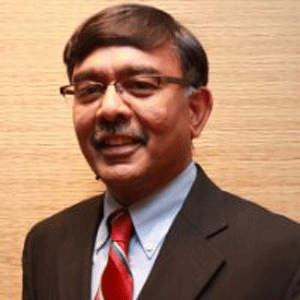
Abelardo Pardo, Associate Professor

Scrum Agile Methodology for Engineering?

Abelardo Pardo

Abelardo Pardo

Some days ago, I had an interesting chat with some colleagues about the merits and demerits of Scrum Agile Methodology and its applications in Engineering.

In my professional life, I have used traditional (waterfall) Project Management, ethodologies, as well as Agile Methodologies, mainly Scrum, as I am Professional Scrum Master Certified.

The Traditional Methodologies are based on a good definition of the product or service requirements upfront.

Changes in the scope are allowed using Change Management, but Agile Methodologies are more focused on those projects where not all requirements could be defined upfront and where changes could occur very often. Let’s say that Agile Methodologies, like Scrum, are more adaptive to customers and market needs. Although Scrum is more focused on software development, it could be used for other sorts of projects, like engineering projects, but only if you could adapt your project to the Scrum framework, artifacts, and tools.

“Agile Methodologies are more focused on those projects where not all requirements could be defined upfront and where changes could occur very often.”

But one of the things that I most like of Scrum is how it is “release” oriented. With traditional project management, you define a product and work through all steps until you get the final product. With Scrum, you divide the product into parts that require less than a month (a Sprint) to be releasable. And after that, you continue developing new releases of the product. The good thing of this is that your time to market is shorter and you could build new releases based on the experience of previous ones.

Obviously, you could not use Scrum in all sort of projects. There are projects that require a traditional approach and other that require Agile methodologies. Some people say Scrum is outdated. It is not, as well as traditional PM is not outdated either. We are in a world where incredible engineering and software developments are produced every day, fortunately on both PM methodologies.

See More: Top Sensor Technology Companies

The articles from these contributors are based on their personal expertise and viewpoints, and do not necessarily reflect the opinions of their employers or affiliated organizations.
The Leadership Perspectives forum brings together voices shaping construction technology and innovation. Participation is by invitation only. It features leaders who are not merely observing technological change, but actively contributing to it through digital transformation and execution-driven insights.
EDITOR'S CHOICE
  • Willis Towers Watson

    ISS Facility Services Australia & New Zealand

    The Right Technology And Reliable Partners; The Business Next Frontier

    Luke O'Brien, CIO

  • Willis Towers Watson

    BPAY Group

    Building BPAY Group's New Digital Foundation

    Angela Donohoe, Chief Information Officer

  • Willis Towers Watson

    Bvn Architecture

    How Have Recent Advancements in Big Data Been Impacting Businesses?

    Marc Solomon, CIO

  • Willis Towers Watson

    Tassal Operations

    BI & Analytics in Aquaculture

    Matthew Leary, CIO

I agree We use cookies on this website to enhance your user experience. By clicking any link on this page you are giving your consent for us to set cookies. More info

APAC CIOOutlook
Follow on LinkedIn

About

  • Home
  • About Us
  • Partner With Us

Stay Connected

  • Subscribe
  • Newsletter
  • Sitemap

Contact Us

  • editor@apacciooutlook.com
  • sales@apacciooutlook.com
  • marketing@apacciooutlook.com

Legal

  • Editorial Policy
  • Privacy Policy
  • Terms of Use

© 2026 APAC CIOOutlook. All rights reserved. Headquarteblue in Fort Lauderdale, FL, USA.

This content is copyright protected

However, if you would like to share the information in this article, you may use the link below:

https://sensor-tech.apacciooutlook.com/cxoinsights/scrum-agile-methodology-for-engineering-nwid-3576.html